View: List Claim type Research area Organism Taxon as written Decade Paper Association author interpretation original result no effect measured Claim · model-written summary
With nitrate available, G. maxima probably did not affect dominant community composition and nitrate metabolism.
composition and nitrate metabolism of the dominant nitrate-reducing community e0 when nitrate was present and available e0 Verbatim
e0 “when nitrate was present and available, the composition and nitrate metabolism of the dominant nitrate-reducing community was probably not affected by G. maxima . ”
✓ located verbatim in the source · abstract, characters 1183–1344 t0 “Glyceria maxima
✓ located verbatim in the source · title, characters 17–32 Other claims from this paper (5) Observation observed original result no effect measured Claim · model-written summary
Loss of hydathode pores in mute did not affect auxin maxima .
did not affect e0 Verbatim
e0 “the absence of hydathode pores in mute did not affect the auxin maxima . ”
✓ located verbatim in the source · abstract, characters 1195–1266 t0 “Arabidopsis
✓ located verbatim in the source · title, characters 86–97 Other claims from this paper (6) Observation observed original result no effect measured Claim · model-written summary
Yields and yield components of C. maxima cultivar Prizewinner were similar at all four sites.
yields and yield components e4 Verbatim
e4 “the yields and yield components of the C. maxima cultivar Prizewinner were similar at all four sites ”
✓ located verbatim in the source · abstract, characters 1177–1277 Other claims from this paper (7) Association observed original result no effect measured Claim · model-written summary
Shifting the growth stage of rice plants did not shift the CH4 emission maxima .
shifting growth stage e1 CH 4 emission maxima e1 Verbatim
e0 “Seasonal variations in CH 4 emission rates from rice paddies ”
✓ located verbatim in the source · abstract, characters 0–60 e1 “shifting growth stage of rice plants did not shift the CH 4 emission maxima ”
✓ located verbatim in the source · abstract, characters 622–697 Other claims from this paper (6) Intervention effect observed original result no effect measured Claim · model-written summary
Glycine, dimethylglycine and TMG had no effect on adventitious roots in C. maxima .
glycine, dimethylglycine, or TMG e0 adventitious roots e0 Not reported Comparator
Verbatim
e0 “One milli molar MeGly inhibited the formation of adventitious roots and their elongation in C . maxima , but glycine, dimethylglycine, or TMG had no effect. ”
✓ located verbatim in the source · abstract, characters 905–1061 Other claims from this paper (8) Observation observed original result no effect not significant (as stated) measured Claim · model-written summary
In must samples, a larger number of maxima (270, 340, 380 nm) was observed, without significant differences between grape varieties.
must samples e1 a larger number of maxima e1 without significant modifications between the grape varieties e1 Verbatim
e1 “For must samples, a larger number of maxima (270, 340, 380 nm) were observed without significant modifications between the grape varieties ”
✓ located verbatim in the source · abstract, characters 1951–2089 Other claims from this paper (6) Intervention effect observed original result no effect not significant (as stated) measured Claim · model-written summary
Oxygen regime produced no statistically significant detected change in exodermal suberin composition or content in G. maxima .
stagnant deep hypoxia conditions e0 exodermal suberin composition or content e0 oxygenated circulating solution e0 Not reported Direction
Verbatim
e0 “Cultivation in stagnant deep hypoxia conditions or oxygenated circulating solution affected the longitudinal pattern of ROL profiles in G. maxima but statistically significant changes in exodermal suberin composition or content were not detected. ”
✓ located verbatim in the source · abstract, characters 920–1166 Other claims from this paper (7) Observation observed original result no effect measured Claim · model-written summary
Magnesium peak-to-background ratio in globoids remained unchanged.
magnesium p/b ratios e3 remained unchanged e3 Verbatim
e0 “Cucurbita maxima Duch. cv. Warted Hubbard ”
✓ located verbatim in the source · abstract, characters 0–41 e3 “while magnesium p/b ratios remained unchanged ”
✓ located verbatim in the source · abstract, characters 521–566 Other claims from this paper (14) Observation observed original result no effect measured Claim · model-written summary
Both cultivars had indistinguishable sucrose contents.
indistinguishable e0 Verbatim
e0 “The amount of sucrose content was indistinguishable in both cultivars ”
✓ located verbatim in the source · abstract, characters 630–699 t0 “Cucurbita maxima and C. moschata ”
✓ located verbatim in the source · title, characters 83–115 Other claims from this paper (7) Observation observed original result no effect measured Claim · model-written summary
The two species produced similar numbers of marketable fruit.
numbers of marketable fruit e0 Verbatim
e0 “Cucurbita maxima and C. pepo produced similar numbers of marketable fruit ”
✓ located verbatim in the source · abstract, characters 832–905 Other claims from this paper (8) Lexical search (BM25). All words must match; if nothing does, any word. Organism names also match every spelling of the same organism. No semantic search yet.
 Glyceria maxima
 Arabidopsis
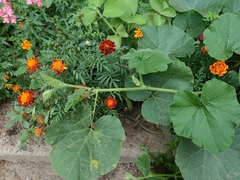 Cucurbita maxima
 Oryza sativa
 Cucurbita moschata