View: List Claim type Research area Organism Taxon as written Decade Paper A claim can belong to several research areas, so group counts add up to more than the total.
Observation observed original result measured Claim · model-written summary
Aggressive C. sativus isolates released more xylanase than weakly aggressive isolates .
weakly aggressive isolates e0 Verbatim
e0 “Aggressive isolates released more xylanase of weakly aggressive isolates . ”
✓ located verbatim in the source · abstract, characters 499–572 t0 “Cochliobolus sativus
✓ located verbatim in the source · title, characters 24–44 Other claims from this paper (4) Observation observed original result measured Claim · model-written summary
Canker isolates were as aggressive as leaf isolates .
as aggressive as leaf isolates e0 leaf isolates e0 Not reported Taxon
Verbatim
e0 “Canker isolates were found to be as aggressive as leaf isolates . ”
✓ located verbatim in the source · abstract, characters 753–817 Other claims from this paper (3) Observation observed original result measured Claim · model-written summary
Highly aggressive cotton V. dahliae isolates secreted more proteins than weakly aggressive ones.
isolates e0 pathogen isolates secreted more proteins e0 weakly aggressive ones e0 Verbatim
e0 “Highly aggressive isolates secreted more proteins than the weakly aggressive ones ”
✓ located verbatim in the source · abstract, characters 1410–1491 e1 “on cotton in Henan ”
✓ located verbatim in the source · abstract, characters 75–93 Other claims from this paper (9) Observation observed original result measured Claim · model-written summary
Three Ascochyta rabiei isolates were highly aggressive , eight fairly aggressive and one less aggressive on chickpea.
highly aggressive isolates e0 Verbatim
e0 “there are three highly aggressive isolates , eight are fairly aggressive and one, is less aggressive . ”
✓ located verbatim in the source · abstract, characters 417–517 t0 “Ascochyta rabiei (Pass.) Labr. in chickpea
✓ located verbatim in the source · title, characters 26–68 Other claims from this paper (1) Observation observed original result negative measured Claim · model-written summary
Five R. bunodes isolates were more aggressive on poplar than the other tested isolates .
more aggressive e0 Verbatim
e0 “R. bunodes isolates R2, R3, R3A, R6 and R8 were more aggressive than the others. ”
✓ located verbatim in the source · abstract, characters 1119–1199 t0 “POPLAR ”
✓ located verbatim in the source · title, characters 54–60 Other claims from this paper (2) Observation observed original result measured Claim · model-written summary
Canker isolates were as aggressive as leaf isolates .
as aggressive as leaf isolates e0 leaf isolates e0 Not reported Taxon
Verbatim
e0 “Canker isolates were found to be as aggressive as leaf isolates . ”
✓ located verbatim in the source · abstract, characters 753–817 Other claims from this paper (3) Observation observed original result negative measured Claim · model-written summary
Pahang isolates were more aggressive on cocoa than Perak isolates .
isolates e0 pathogen more aggressive e0 isolates from Perak e0 Verbatim
e0 “the isolates obtained from Pahang are more aggressive compared to the isolates from Perak. ”
✓ located verbatim in the source · abstract, characters 843–933 t0 “cocoa ”
✓ located after whitespace/quote normalisation · title, characters 122–127 Other claims from this paper (5) Observation observed original result negative measured Claim · model-written summary
NA2 and EU1 Phytophthora ramorum isolates were most aggressive on detached Rhododendron leaves, while NA1 isolates were least aggressive .
most aggressive e1 Verbatim
e0 “aggressive ness on detached Rhododendron leaves ”
✓ located verbatim in the source · abstract, characters 228–274 e1 “Isolates from the NA2 and EU1 lineages were the most aggressive and isolates from the NA1 group were the least aggressive . ”
✓ located verbatim in the source · abstract, characters 502–624 t0 “Phytophthora ramorum
✓ located verbatim in the source · title, characters 54–74 Other claims from this paper (3) Observation observed original result positive measured Claim · model-written summary
Hypo- aggressive and moderately aggressive isolates carried 0–6 SIX genes.
isolates carried e0 hypo-aggressive and moderately aggressive isolates e0 Verbatim
e0 “hypo- aggressive and moderately aggressive isolates carried 0–6 ”
✓ located verbatim in the source · abstract, characters 610–672 t0 “loss of 75% of date palm trees ”
✓ located verbatim in the source · abstract, characters 101–131 e1 “Fusarium oxysporum f. sp . Albedinis (Foa) is the causal agent of Bayoud disease
✓ located verbatim in the source · abstract, characters 0–79 Other claims from this paper (5) Association observed original result measured Claim · model-written summary
ExoPG expression was higher in highly aggressive isolates than weakly aggressive isolates in response to potato leaf and stem extracts.
leaf and stem e0 potato leaf and stem extracts e0 weakly aggressive isolate e0 Verbatim
e0 “ExoPG expressed more in the highly aggressive than in the weakly aggressive isolate in response to potato leaf and stem extracts. ”
✓ located verbatim in the source · abstract, characters 638–767 t0 “Potato-Verticillium dahliae ”
✓ located verbatim in the source · title, characters 46–73 Other claims from this paper (8) Observation observed original result measured Claim · model-written summary
Highly aggressive C. coccodes isolates secreted detectable PL at 6 h versus 12 h for mildly aggressive isolates .
highly aggressive isolates secreted immunologically detectable PL levels e0 mildly aggressive isolates e0 Verbatim
e0 “In vitro-cultivated highly aggressive isolates secreted immunologically detectable PL levels 6 h after transfer to secondary medium versus 12 h for mildly aggressive isolates , suggesting that secreted PL is a virulence factor. ”
✓ located verbatim in the source · abstract, characters 264–490 t0 “Colletotrichum coccodes
✓ located verbatim in the source · title, characters 59–82 e1 “Colletotrichum coccodes (Wallr.) S. Hughes, the causal agent of black dot on potato and anthracnose on tomato, reduces yield and crop quality.
✓ located verbatim in the source · abstract, characters 0–142 Other claims from this paper (9) Observation observed original result significant (as stated) measured Claim · model-written summary
Aggressive isolates suppressed peroxidase more than nonaggressive isolates .
more suppressive e0 more suppressive e0 Not reported Taxon
Verbatim
e0 “aggressive isolates were significantly more suppressive than non- aggressive ones ”
✓ located verbatim in the source · abstract, characters 1288–1368 Other claims from this paper (14) Mechanism author interpretation original result negative measured Claim · model-written summary
The authors propose that hydroxycinnamate accumulation after weak isolate priming could explain restricted symptom development from later highly aggressive isolates .
priming with a weakly aggressive isolate e0 restricted development of further inoculated highly aggressive isolates e0 Verbatim
e0 “their detected amounts in response to the priming with a weakly aggressive isolate could explain the restricted development of further inoculated highly aggressive isolates ”
✓ located verbatim in the source · abstract, characters 1371–1543 t0 “canola ”
✓ located verbatim in the source · title, characters 8–14 Other claims from this paper (1) Observation observed original result measured Claim · model-written summary
Aggressive isolates induced OH* peaks within 24 h.
OH* radical formation e0 Not reported Taxon
Verbatim
e0 “Aggressive isolates induced peak signals of OH* radical formation within 24 h ”
✓ located verbatim in the source · abstract, characters 878–955 Other claims from this paper (14) Association observed original result positive measured Claim · model-written summary
On wild Cicer , wild-origin isolates were generally more aggressive .
more aggressive e0 t0 isolates from domesticated origin e0 t0 Verbatim
e0 “On C. judaicum , isolates from wild origin were generally more aggressive than isolates from domesticated origin ”
✓ located verbatim in the source · abstract, characters 1152–1263 t0 “Different Ecological Affinities and Aggressive ness Patterns Among Didymella rabiei Isolates from Sympatric Domesticated Chickpea and Wild Cicer judaicum ”
✓ located verbatim in the source · title, characters 0–152 Other claims from this paper (3) Observation observed original result positive measured Claim · model-written summary
Wild-origin isolates were less aggressive on their original host than other isolates .
Isolates e0 pathogen less aggressive than other isolates on their host of origin e0 Verbatim
e0 “Isolates from wild habitats in the centre of origin of the crop were not pathogenic on the domesticated apple and less aggressive than other isolates on their host of origin. ”
✓ located verbatim in the source · abstract, characters 576–750 Other claims from this paper (6) Observation observed original result measured Claim · model-written summary
Highly aggressive ginseng isolates from Ontario, Korea and Japan have identical ITS and beta-tubulin sequences.
highly aggressive ginseng isolates from Ontario, Korea, and Japan e0 identical ITS and beta-tubulin sequences e0 Verbatim
e0 “Certain highly aggressive ginseng isolates from Ontario, Korea, and Japan have identical ITS and beta-tubulin sequences ”
✓ located verbatim in the source · abstract, characters 737–856 Other claims from this paper (8) Method / resource observed original result positive measured Claim · model-written summary
Molecular techniques distinguished aggressive from non- aggressive isolates .
aggressive and non-aggressive isolates of L. maculans e0 Verbatim
e0 “These aggressive and non- aggressive isolates of L. maculans can be distinguished by molecular techniques including electrophoretic karyotyping, Southern analysis of the ribosomal RNA gene repeat, Random Amplified Polymorphic DNA (RAPD) marker analysis, and pigment production ”
✓ located verbatim in the source · abstract, characters 369–644 t0 “oilseed rape (Brassica napus ) ”
✓ located verbatim in the source · abstract, characters 103–132 Other claims from this paper (2) Method / resource observed original result measured Claim · model-written summary
The study identified aggressive isolates that distinguished bean lines more efficiently.
more efficient in distinguishing the lines e0 the most aggressive isolates e0 Verbatim
e0 “It was also possible to identify the most aggressive isolates that were more efficient in distinguishing the lines ”
✓ located verbatim in the source · abstract, characters 1376–1490 e1 “common bean (Phaseolus vulgaris ) lines ”
✓ located verbatim in the source · abstract, characters 390–428 e2 “Sclerotinia sclerotiorum isolates ”
✓ located verbatim in the source · abstract, characters 121–154 Other claims from this paper (4) Method / resource observed original result positive measured Claim · model-written summary
The aggressive -group primer pair unequivocally identifies A- isolates of Leptosphaeria maculans among 97 isolates tested.
identifies A‐isolates e1 Verbatim
e0 “Polymerase chain reaction (PCR) primers, specific for the aggressive pathogenicity group of the rape seed pathogen Leptosphaeria maculans ”
✓ located verbatim in the source · abstract, characters 9–146 e1 “The primer pair specific for the aggressive pathogenicity group unequivocally identifies A‐ isolates ”
✓ located verbatim in the source · abstract, characters 755–854 e2 “tested on 97 isolates of L. maculans belonging to different pathogenicity groups ”
✓ located verbatim in the source · abstract, characters 673–753 Other claims from this paper (5) Lexical search (BM25). All words must match; if nothing does, any word. Organism names also match every spelling of the same organism. No semantic search yet.
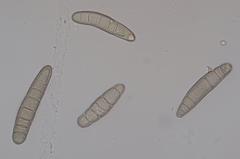 Bipolaris sorokinianat0
 Gossypium hirsutum
 Cicer arietinum
 Ascochyta rabiei
 Populus
 Theobroma cacao
 Rhododendron
 Phytophthora ramorum
 Phoenix dactylifera
 Fusarium oxysporum
 Solanum tuberosum
 Verticillium dahliae
 Solanum lycopersicum
 Colletotrichum coccodes
 Brassica napus var. napus
 Malus domestica
 Panax ginseng
 Brassica napus
 Plenodomus lingam
 Phaseolus vulgaris
 Sclerotinia sclerotiorum