View: List Claim type Research area Organism Taxon as written Decade Paper Observation observed original result measured Claim · model-written summary
Resistant and less resistant accessions belong to Cucurbita maxima , C. maxima subsp. maxima , C. maxima subsp. andreana and C. okeechobeensis subsp. martinezii .
Verbatim
e0 “Resistant and less resistant accessions belong to the species Cucurbita maxima , C . maxima subsp. maxima , C . maxima subsp. andreana , and C . okeechobeensis subsp. martinezii ”
✓ located verbatim in the source · abstract, characters 1351–1528 Other claims from this paper (7) Observation observed original result measured Claim · model-written summary
Seed surface ultrastructure distinguishes Spergula maxima from Spergula arvensis subsp. arvensis , supporting Spergula arvensis subsp. maxima .
Spergula arvensis subsp. maxima e0 Verbatim
e0 “between Spergula maxima and Spergula arvensis subsp. arvensis , accordingly we propose — Spergula arvensis subsp. maxima
✓ located verbatim in the source · abstract, characters 1538–1657 Other claims from this paper (7) Observation observed original result measured Claim · model-written summary
Laboratory germination maxima preceded field emergence maxima by 12 to 26 days.
laboratory germination test maxima e0 field emergence maxima e0 Verbatim
e0 “laboratory germination test maxima preceded field emergence maxima by 12 to 26 d. ”
✓ located verbatim in the source · abstract, characters 1050–1131 t0 “Sweet Corn ”
✓ located verbatim in the source · title, characters 81–91 Other claims from this paper (16) Intervention effect observed original result positive measured Claim · model-written summary
Fertilization had a more positive effect on Glyceria maxima .
Not reported Comparator
Verbatim
e0 “fertilization had a more positive effect on G. maxima
✓ located verbatim in the source · abstract, characters 1839–1892 t0 “Carex acuta and Glyceria maxima
✓ located verbatim in the source · title, characters 70–101 Other claims from this paper (9) Intervention effect observed original result no effect measured Claim · model-written summary
Heteroauxin was ineffective for parthenocarpy in maxima .
not effective to maxima spe-cies e0 Not reported Comparator Direction
Verbatim
e0 “Heteroauxin was effective to Pepo and mos-chata species, but was not effective to maxima spe-cies ”
✓ located verbatim in the source · abstract, characters 120–217 Other claims from this paper (6) Intervention effect observed original result negative measured Claim · model-written summary
Flooding stressed Glyceria maxima .
Not reported Comparator Direction
Verbatim
e0 “Both species were stressed when flooded, but C. acuta more so than G. maxima
✓ located verbatim in the source · abstract, characters 1895–1971 Other claims from this paper (9) Association observed original result measured Claim · model-written summary
The CH4 emission maxima often matched the maxima of daily mean air temperature.
CH 4 emission maxima e2 maxima of daily mean air temperature e2 Verbatim
e0 “Seasonal variations in CH 4 emission rates from rice paddies ”
✓ located verbatim in the source · abstract, characters 0–60 e2 “the CH 4 emission maxima often matched the maxima of daily mean air temperature ”
✓ located verbatim in the source · abstract, characters 703–782 Other claims from this paper (6) Association observed original result significant (as stated) measured Claim · model-written summary
Citrus maxima peel extract had higher fat (9.74%) than the juice.
peel extract e1 Citrus maxima juicee1 Verbatim
e1 “Citrus maxima peel extract contains significantly ( p < .05) higher crude fiber (2.58%), fat (9.74%), ash (2.49%), and carbohydrate (71.57%) compared with Citrus maxima juice ”
✓ located verbatim in the source · abstract, characters 888–1062 Other claims from this paper (9) Association observed original result significant (as stated) measured Claim · model-written summary
Citrus maxima peel extract had higher ash (2.49%) than the juice.
peel extract e1 Citrus maxima juicee1 Verbatim
e1 “Citrus maxima peel extract contains significantly ( p < .05) higher crude fiber (2.58%), fat (9.74%), ash (2.49%), and carbohydrate (71.57%) compared with Citrus maxima juice ”
✓ located verbatim in the source · abstract, characters 888–1062 Other claims from this paper (9) Mechanism observed original result negative measured Claim · model-written summary
Glyceria maxima suppressed potential nitrifying activities through ammonium uptake.
Potential nitrifying activities e0 ammonium uptake by the plants e0 Verbatim
e0 “Potential nitrifying activities were suppressed by G. maxima due to ammonium uptake by the plants ”
✓ located verbatim in the source · abstract, characters 773–870 Other claims from this paper (8) Mechanism observed original result positive simulated Claim · model-written summary
CUC2 promotes PIN1-dependent auxin activity maxima .
PIN1-dependent auxin activity maxima e0 Verbatim
e0 “CUC2 promotes the generation of PIN1-dependent auxin activity maxima ”
✓ located verbatim in the source · abstract, characters 1148–1216 t0 “Arabidopsis thaliana
✓ located verbatim in the source · title, characters 28–48 Other claims from this paper (5) Mechanism observed original result measured Claim · model-written summary
Ammonium rather than oxygen appeared limiting for nitrification in the Glyceria maxima root zone.
ammonium, and not oxygen e0 Verbatim
e0 “Apparently ammonium, and not oxygen, was the limiting factor for nitrification in the root zone of G. maxima
✓ located verbatim in the source · abstract, characters 1306–1414 Other claims from this paper (8) Method / resource observed original result basis n/a Claim · model-written summary
The Nepenthes maxima cultivar Lake Poso is described.
Nepenthes maxima 'Lake Poso'e0 Nepenthes maxima 'Lake Poso'e0 Not reported Comparator Value
Verbatim
e0 “Nepenthes maxima 'Lake Poso' ”
✓ located verbatim in the source · abstract, characters 54–82 Other claims from this paper (5) Method / resource observed original result negative simulated Claim · model-written summary
That adjustment gave predicted maxima about 25% below observations.
predicted maxima e0 observed maxima e0 Not reported Taxon
Verbatim
e0 “predicted maxima approximately 25% less than the observed maxima ”
✓ located verbatim in the source · abstract, characters 1308–1372 Other claims from this paper (5) Method / resource observed original result measured Claim · model-written summary
The linkage analysis revealed 20 genetic linkage groups of Cucurbita maxima .
genetic linkage groups e0 Verbatim
t0 “Cucurbita maxima
✓ located verbatim in the source · title, characters 23–39 e0 “revealed 20 genetic linkage groups of C. maxima
✓ located verbatim in the source · abstract, characters 309–356 Other claims from this paper (3) Recommendation author interpretation original result basis n/a Claim · model-written summary
C. maxima varieties should be stem-regulated.
should be stem-regulated e0 Verbatim
e0 “five varieties of C. maxima were fit for cultivating in spring and should be stem-regulated ”
✓ located verbatim in the source · abstract, characters 126–216 t0 “Cucurbita maxima
✓ located verbatim in the source · title, characters 34–50 Other claims from this paper (5) Recommendation author interpretation original result positive basis n/a Claim · model-written summary
Selection of C. maxima genotypes with resistance to ZYMV should be efficient.
selection of C. maxima genotypes with resistance to ZYMV e1 Verbatim
e1 “implying that selection of C. maxima genotypes with resistance to ZYMV should be efficient ”
✓ located verbatim in the source · abstract, characters 378–468 Other claims from this paper (3) Recommendation author interpretation original result basis n/a Claim · model-written summary
The authors suggest useful C. ecuadorensis traits could be introgressed into C. maxima .
useful traits of C. ecuadorensis could be introgressed into C. maxima e0 Verbatim
e0 “and that much of the useful traits of C. ecuadorensis could be introgressed into C. maxima . ”
✓ located verbatim in the source · abstract, characters 1394–1485 Other claims from this paper (11) Lexical search (BM25). All words must match; if nothing does, any word. Organism names also match every spelling of the same organism. No semantic search yet.
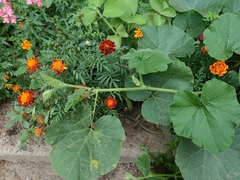 Cucurbita maximae0
 Glyceria maxima
 Oryza sativa
 Citrus maxima
 Arabidopsis thaliana
 Nepenthes maxima
 Zucchini yellow mosaic virus