View: List Claim type Research area Organism Taxon as written Decade Paper Method / resource observed original result negative simulated Claim · model-written summary
That adjustment gave predicted maxima about 25% below observations.
predicted maxima e0 observed maxima e0 Not reported Taxon
Verbatim
e0 “predicted maxima approximately 25% less than the observed maxima ”
✓ located verbatim in the source · abstract, characters 1308–1372 Other claims from this paper (5) Observation observed original result negative measured Claim · model-written summary
Ralstonia solanacearum caused Cucurbita maxima bacterial wilt.
C. maxima bacterial wilte0 Verbatim
e0 “the pathogen of C. maxima bacterial wilt was Ralstonia solanacearum ”
✓ located verbatim in the source · abstract, characters 876–943 Other claims from this paper (12) Observation observed original result negative measured Claim · model-written summary
Cucurbita maxima was highly susceptible to ToLCNDV.
highly susceptible e4 Verbatim
e4 “Cucurbita maxima and C. ficifolia were also highly susceptible ”
✓ located verbatim in the source · abstract, characters 878–940 Other claims from this paper (11) Intervention effect observed original result negative measured Claim · model-written summary
Flooding stressed Glyceria maxima .
Not reported Comparator Direction
Verbatim
e0 “Both species were stressed when flooded, but C. acuta more so than G. maxima
✓ located verbatim in the source · abstract, characters 1895–1971 Other claims from this paper (9) Observation observed original result negative measured Claim · model-written summary
C. maxima was highly susceptible to ToLCNDV.
highly susceptible e0 Verbatim
e0 “C. maxima was also highly susceptible. ”
✓ located verbatim in the source · abstract, characters 1350–1388 Other claims from this paper (12) Observation observed original result negative measured Claim · model-written summary
Bacterial wilt was observed on Cucurbita maxima in Guangdong.
Guangdong province, China e0 Verbatim
e0 “a new bacterial wilt on Cucurbita maxima was observed in Guangdong province, China ”
✓ located verbatim in the source · abstract, characters 174–256 Other claims from this paper (12) Intervention effect observed original result negative measured Claim · model-written summary
Silencing CmWRKY22 promoted CMV infection in C. maxima .
silencing CmWRKY22 e0 cucumber mosaic virus (CMV) infection e0 Not reported Comparator
Verbatim
e0 “silencing CmWRKY22 promoted cucumber mosaic virus (CMV) infection ”
✓ located verbatim in the source · abstract, characters 545–610 t0 “Cucurbita maxima
✓ located verbatim in the source · title, characters 75–91 Other claims from this paper (3) Observation observed original result negative measured Claim · model-written summary
Armigeres subalbatus was more resistant to Citrus maxima peel oil.
Armigeres subalbatus was more resistante0 more resistant e0 Verbatim
e0 “however, Armigeres subalbatus was more resistant. ”
✓ located verbatim in the source · abstract, characters 772–821 t0 “Pomelo (Citrus maxima ) Peel ”
✓ located verbatim in the source · title, characters 15–42 Other claims from this paper (5) Mechanism observed original result negative measured Claim · model-written summary
Glyceria maxima suppressed potential nitrifying activities through ammonium uptake.
Potential nitrifying activities e0 ammonium uptake by the plants e0 Verbatim
e0 “Potential nitrifying activities were suppressed by G. maxima due to ammonium uptake by the plants ”
✓ located verbatim in the source · abstract, characters 773–870 Other claims from this paper (8) Observation observed original result negative measured Claim · model-written summary
Auxin maxima distribution expanded ectopically in ibr5-3.
distribution of auxin maxima e0 expanded ectopically e0 Not reported Taxon
Verbatim
e0 “the distribution of auxin maxima was expanded ectopically in ibr5-3. ”
✓ located verbatim in the source · abstract, characters 845–913 Other claims from this paper (5) Lexical search (BM25). All words must match; if nothing does, any word. Organism names also match every spelling of the same organism. No semantic search yet.
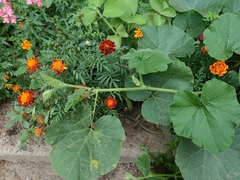 Cucurbita maxima
 Ralstonia solanacearum
 Glyceria maxima
 cucumber mosaic cucumovirus
 Citrus maxima