View: List Claim type Research area Organism Taxon as written Decade Paper Method / resource observed original result measured Claim · model-written summary
The linkage analysis revealed 20 genetic linkage groups of Cucurbita maxima .
genetic linkage groups e0 Verbatim
t0 “Cucurbita maxima
✓ located verbatim in the source · title, characters 23–39 e0 “revealed 20 genetic linkage groups of C. maxima
✓ located verbatim in the source · abstract, characters 309–356 Other claims from this paper (3) Observation observed original result negative measured Claim · model-written summary
Ralstonia solanacearum caused Cucurbita maxima bacterial wilt.
C. maxima bacterial wilte0 Verbatim
e0 “the pathogen of C. maxima bacterial wilt was Ralstonia solanacearum ”
✓ located verbatim in the source · abstract, characters 876–943 Other claims from this paper (12) Observation observed original result measured Claim · model-written summary
Oospores were absent in C. maxima .
Verbatim
e0 “C. maxima (cv. Tripoli) ”
✓ located verbatim in the source · abstract, characters 1564–1587 Other claims from this paper (19) Observation observed original result measured Claim · model-written summary
Resistant and less resistant accessions belong to Cucurbita maxima , C. maxima subsp. maxima , C. maxima subsp. andreana and C. okeechobeensis subsp. martinezii .
Verbatim
e0 “Resistant and less resistant accessions belong to the species Cucurbita maxima , C . maxima subsp. maxima , C . maxima subsp. andreana , and C . okeechobeensis subsp. martinezii ”
✓ located verbatim in the source · abstract, characters 1351–1528 Other claims from this paper (7) Observation observed original result measured Claim · model-written summary
Seed surface ultrastructure distinguishes Spergula maxima from Spergula arvensis subsp. arvensis , supporting Spergula arvensis subsp. maxima .
Spergula arvensis subsp. maxima e0 Verbatim
e0 “between Spergula maxima and Spergula arvensis subsp. arvensis , accordingly we propose — Spergula arvensis subsp. maxima
✓ located verbatim in the source · abstract, characters 1538–1657 Other claims from this paper (7) Observation observed original result positive measured Claim · model-written summary
C. maxima showed high genotypic variability.
genotypic variability e0 Verbatim
e0 “This study proved the existence of high genotypic variability in C. maxima
✓ located verbatim in the source · abstract, characters 1087–1161 Other claims from this paper (3) Method / resource observed original result basis n/a Claim · model-written summary
The Nepenthes maxima cultivar Lake Poso is described.
Nepenthes maxima 'Lake Poso'e0 Nepenthes maxima 'Lake Poso'e0 Not reported Comparator Value
Verbatim
e0 “Nepenthes maxima 'Lake Poso' ”
✓ located verbatim in the source · abstract, characters 54–82 Other claims from this paper (5) Observation observed original result measured Claim · model-written summary
Five C. maxima varieties were suitable for spring cultivation.
fit for cultivating in spring e0 Verbatim
e0 “five varieties of C. maxima were fit for cultivating in spring ”
✓ located verbatim in the source · abstract, characters 126–187 t0 “Cucurbita maxima
✓ located verbatim in the source · title, characters 34–50 Other claims from this paper (5) Recommendation author interpretation original result basis n/a Claim · model-written summary
C. maxima varieties should be stem-regulated.
should be stem-regulated e0 Verbatim
e0 “five varieties of C. maxima were fit for cultivating in spring and should be stem-regulated ”
✓ located verbatim in the source · abstract, characters 126–216 t0 “Cucurbita maxima
✓ located verbatim in the source · title, characters 34–50 Other claims from this paper (5) Observation observed original result measured Claim · model-written summary
Laboratory germination maxima preceded field emergence maxima by 12 to 26 days.
laboratory germination test maxima e0 field emergence maxima e0 Verbatim
e0 “laboratory germination test maxima preceded field emergence maxima by 12 to 26 d. ”
✓ located verbatim in the source · abstract, characters 1050–1131 t0 “Sweet Corn ”
✓ located verbatim in the source · title, characters 81–91 Other claims from this paper (16) Method / resource observed original result negative simulated Claim · model-written summary
That adjustment gave predicted maxima about 25% below observations.
predicted maxima e0 observed maxima e0 Not reported Taxon
Verbatim
e0 “predicted maxima approximately 25% less than the observed maxima ”
✓ located verbatim in the source · abstract, characters 1308–1372 Other claims from this paper (5) Observation observed original result basis n/a Claim · model-written summary
A new species, M. maxima , was described from Northern Peru.
Verbatim
e0 “M. maxima
✓ located verbatim in the source · abstract, characters 53–62 t0 “Muhlenbergia and Uniola
✓ located verbatim in the source · title, characters 21–44 e1 “Northern Peru ”
✓ located verbatim in the source · abstract, characters 103–116 Other claims from this paper (2) Observation observed original result measured Claim · model-written summary
Spring nodular activity maxima were 8-250 times summer minima.
native Australian legumes t0 8-250 times summer minima e0 Verbatim
e0 “spring maxima 8-250 times summer minima ”
✓ located verbatim in the source · abstract, characters 455–494 t0 “Native Australian Legumes ”
✓ located verbatim in the source · title, characters 21–46 Other claims from this paper (4) Observation observed original result measured Claim · model-written summary
The pigments had similar emission maxima .
similar emission maxima e0 Not reported Direction
Verbatim
e0 “the two tetrapyrroles exhibited similar emission maxima ”
✓ located verbatim in the source · abstract, characters 212–267 e1 “higher plants ”
✓ located verbatim in the source · abstract, characters 65–78 Other claims from this paper (7) Observation observed original result basis n/a Claim · model-written summary
Tillandsia maxima becomes T. australis .
T. australis Meze0 Verbatim
e0 “Tillandsia maxima Lillo & Hauman becomes T. australis Mez ”
✓ located verbatim in the source · abstract, characters 462–519 Other claims from this paper (7) Observation observed original result no effect measured Claim · model-written summary
Absorption maxima matched within each fertile and sterile pair.
absorption maxima e0 fertile-sterile combination e0 Verbatim
e0 “absorption maxima were identical for each fertile-sterile combination. ”
✓ located verbatim in the source · abstract, characters 262–332 t0 “Maize ”
✓ located verbatim in the source · title, characters 0–5 Other claims from this paper (5) Intervention effect observed original result no effect measured Claim · model-written summary
Low temperature did not delay climacteric maxima .
lowtemperature e0 attainment oftheclimacteric maxima e0 no_change inferred e0 Not reported Comparator
Verbatim
e0 “butlowtemperature didnotdelay attainment oftheclimacteric maxima ”
✓ located verbatim in the source · abstract, characters 324–388 t0 “TomatoFruits ”
✓ located verbatim in the source · title, characters 93–105 Other claims from this paper (4) Observation author interpretation review summary basis n/a Claim · model-written summary
Biota shifted substantially southward during glacial maxima .
southward displacement of biota e0 during glacial maxima e0 Verbatim
e0 “significant southward displacement of biota took place during glacial maxima . ”
✓ located verbatim in the source · abstract, characters 216–293 Other claims from this paper (10) Observation observed original result measured Claim · model-written summary
Germination inactivation had maxima at 720 and 740 mμ.
maxima at 720 and 740 mμ for inactivation e1 Verbatim
e0 “the crucifer, Arabidopsis thaliana ”
✓ located verbatim in the source · abstract, characters 83–117 e1 “two maxima at 720 and 740 mμ for inactivation ”
✓ located verbatim in the source · abstract, characters 251–296 Other claims from this paper (6) Observation observed original result positive measured Claim · model-written summary
Preanthesis bud pollination produced C. pepo × C. maxima hybrids.
Bud pollination at at 7 a.m. of the day before anthesis e0 C. pepo x C. maxima e0 Not reported Direction
Verbatim
e0 “Bud pollination at at 7 a.m. of the day before anthesis ; C. pepo x C. maxima . ”
✓ located verbatim in the source · abstract, characters 1392–1470 t0 “C. pepo , C. moschata and C. maxima
✓ located verbatim in the source · title, characters 75–109 Other claims from this paper (9) Observation observed original result measured Claim · model-written summary
Gossyverdurin had absorption maxima at 250, 370 and 560 mॖ.
absorption maxima e2 250, 370, and 560 mॖ e2 Verbatim
t0 “cottonseed pigment glands ”
✓ located verbatim in the source · title, characters 45–70 e2 “Gossyverdurin showed absorption maxima at 250, 370, and 560 mॖ. ”
✓ located verbatim in the source · abstract, characters 470–533 Other claims from this paper (5) Observation observed original result measured Claim · model-written summary
Pollen tube growth differed for the C. maxima ×C. moschata (Fig. 3) cross.
C. maxima ×C. moschata (Fig. 3)e0 Verbatim
e0 “C. maxima ×C. moschata (Fig. 3) ”
✓ located verbatim in the source · abstract, characters 318–348 Other claims from this paper (10) Observation observed original result measured Claim · model-written summary
Pollen tube growth differed for the C. maxima ×C. pepo (Fig. 4) cross.
C. maxima ×C. pepo (Fig. 4)e0 Verbatim
e0 “C. maxima ×C. pepo (Fig. 4) ”
✓ located verbatim in the source · abstract, characters 382–409 Other claims from this paper (10) Observation observed original result measured Claim · model-written summary
Crosses between C. maxima and C. moschata were incompletely compatible.
Verbatim
e0 “C. maxima と C. moschata との間の交雜は不完全な和合性である ”
✓ located verbatim in the source · abstract, characters 596–637 Other claims from this paper (10) Observation observed original result measured Claim · model-written summary
A perinuclear zone forms in early diakinesis.
early diakinesis e0 perinuclear zone is formed e0 Verbatim
e0 “During early diakinesis a perinuclear zone is formed ”
✓ located verbatim in the source · abstract, characters 224–276 t0 “Cucurbita maxima
✓ located verbatim in the source · title, characters 20–36 Other claims from this paper (7) Observation observed original result measured Claim · model-written summary
Twenty bivalent chromosomes occur at heterotypic division.
bivalent chromosomes e0 twenty bivalent chromosomes e0 Verbatim
e0 “There are twenty bivalent chromosomes at the heterotypic division ”
✓ located verbatim in the source · abstract, characters 407–472 t0 “Cucurbita maxima
✓ located verbatim in the source · title, characters 20–36 Other claims from this paper (7) Mechanism author interpretation original result measured Claim · model-written summary
Earlier environmental conditions controlled the timing of growth maxima .
incidence of the maxima e0 environmental conditions e0 Verbatim
e0 “The incidence of the maxima is controlled by environmental conditions—not by the environmental conditions operating at the time, but by those obtaining at some previous stage in the life‐history of the plant ”
✓ located verbatim in the source · abstract, characters 2292–2499 e1 “for maize throughout its life‐cycle ”
✓ located verbatim in the source · abstract, characters 939–974 Other claims from this paper (10) Observation observed original result measured Claim · model-written summary
Cucurbita maxima has twenty bivalent chromosomes.
bivalent chromosomes e0 Verbatim
e0 “Cucurbita pepo and C. maxima each has twenty bivalent chromosomes ”
✓ located verbatim in the source · abstract, characters 171–236 Other claims from this paper (10) Observation observed original result measured Claim · model-written summary
Cucurbita moschata and C. maxima gave an interspecific cross.
species crosses were obtained e1 between Cucurbita moschata and C. maxima e1 Verbatim
e1 “Three species crosses were obtained: (1) between Cucurbita moschata and C. maxima
✓ located verbatim in the source · abstract, characters 752–833 Other claims from this paper (18) Observation observed original result measured Claim · model-written summary
Shoot-number curves resembled one another after their maxima despite varying maxima .
shoot-number curves e0 marked resemblance e0 Verbatim
e0 “The shoot-number curves bear a marked resemblance to one another subsequent to the period when the shoot number is a maximum in spite of the wide divergences which exist between the maximum shoot numbers themselves. ”
✓ located verbatim in the source · abstract, characters 494–709 t0 “wheat ”
✓ located verbatim in the source · title, characters 47–52 Other claims from this paper (6) Lexical search (BM25). All words must match; if nothing does, any word. Organism names also match every spelling of the same organism. No semantic search yet.
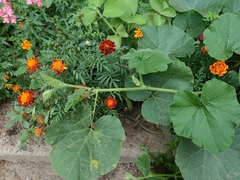 Cucurbita maximat0
 Ralstonia solanacearum
 Citrus maxima
 Nepenthes maxima
 Zea mays
 Arabidopsis thaliana
 Cucurbita moschata
 Cucurbita pepo
 Triticum aestivum